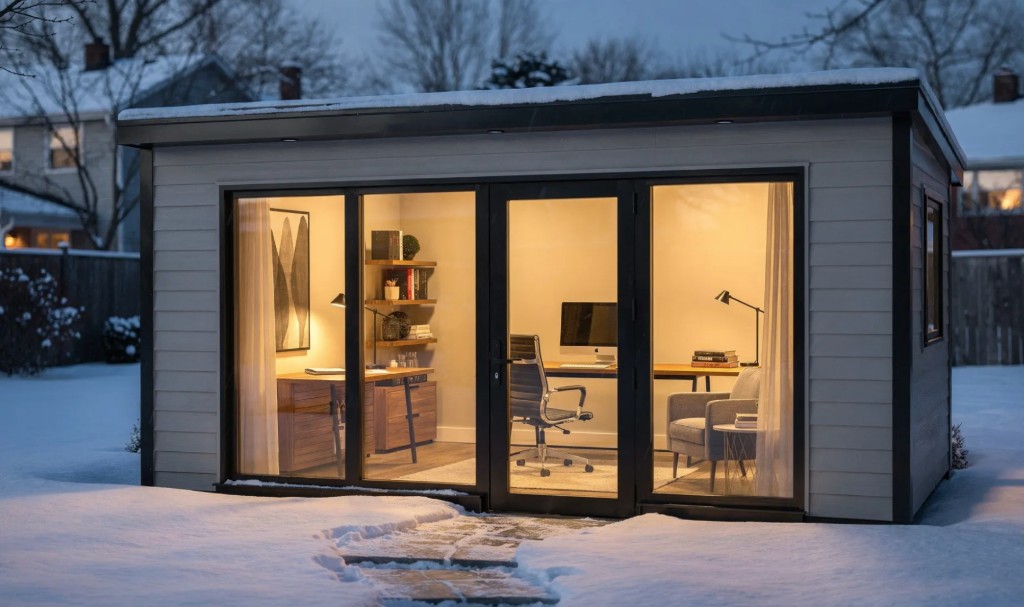
Outdoor living planning
A winter-ready backyard office in North Jersey starts with a tight insulated envelope before you size the heat source.
To make a backyard office truly winter-ready in North Jersey, you need a tight, insulated envelope with walls at R-20 or better and roof at R-49, cold-climate heat, sealed windows and doors, and controlled ventilation. A site-built studio gives you purpose-built comfort and flexibility. An insulated garage conversion can be faster and cheaper, but demands careful slab, door, and air-sealing upgrades.
9 min read
$28K–$55K+
Site-built 10x12
Planning ballpark
$20K–$45K+
Garage conversion
Planning ballpark
R-49
Roof target
Ceiling insulation
4–8 wks
Site-built build
After permits
Key takeaway
To make a backyard office truly winter-ready in North Jersey, you need a tight, insulated envelope with walls at R-20 or better and roof at R-49, cold-climate heat, sealed windows and doors, and controlled ventilation.
What you will learn from this guide
- The must-have specs that actually make a backyard office winter-ready in North Jersey
- Pros, cons, costs, and timelines for a site-built studio vs an insulated garage conversion
- How to size heating, choose windows, and control moisture so it feels cozy at 10°F
- Permit basics, utilities, and a simple step-by-step plan to get from idea to move-in
Start here: the winter-ready bottom line (envelope first, heat second)
If you remember one thing, make it this: warmth starts with what you keep out, not what you pour in. In practice, that means a continuous air barrier, solid insulation, and dry, controlled air. Picture a January 7 a.m. Zoom call: your coffee is hot, your toes are warm, and the space is quiet. That is not luck. It is envelope plus right-sized heat.
NJ Vinyl Siding site-builds backyard studios and coordinates garage conversions across Bergen, Passaic, Essex, Morris, and nearby counties. Electrical and HVAC work runs through licensed subs named on your written proposal.
- Walls: R-20 or R-13 plus continuous exterior insulation (R-5 to R-10). 2x6 with dense-packed cellulose or mineral wool is common. Adding exterior foam cuts drafts and condensation risk.
- Roof and ceiling: R-49 is the sweet spot. Vented attic or unvented cathedral with rigid foam or spray foam. Pick one clear strategy and detail it cleanly.
- Floor and slab: Insulate edges and, where possible, add foam under or over the slab. Insulated subfloor panels work well for garage conversions.
- Windows and doors: Double-pane, low-E, U-factor around 0.28 to 0.30. Good weatherstripping. Install with taped and flashed openings.
- Air sealing: Meticulous caulk, tape, and gaskets. Target a tight shell, then add balanced ventilation.
- Ventilation: Small ERV at 30 to 60 CFM keeps air fresh without dumping heat.
- Heat: Cold-climate mini-split sized for design temps near single digits. Consider a quiet backup like a panel heater.
Your step-by-step plan from idea to move-in
- Define size and layout for desk, storage, and any exercise zone
- Pick assembly: 2x6 plus exterior foam or 2x4 with more exterior foam
- Choose windows and door package with low-E glass and proper flashing
- Seal the shell with WRB, tapes, and gaskets at every penetration
- Insulate roof, walls, and floor to code and comfort targets
- Install ERV and cold-climate mini-split through licensed HVAC subs
- Run power, data, and lighting through permitted buried conduit
- Finish interior with drywall, trim, and flooring suited to your use
- Test for drafts at sills, corners, and electrical boxes
- Move in and tune humidity with the ERV running
Dreaming up a site-built backyard studio: the smart path
Site-built shines when you want a quiet, dedicated space with premium comfort. Think of it like a compact, high-performance cabin that just happens to be in your yard. NJ Vinyl Siding frames studios with proper insulation, air sealing, and siding that matches your home so the structure reads as part of the property.
Foundation that will not shiver: helical piers or poured footings below local frost depth, often around 30 to 36 inches. Verify with your code official. For slabs, add rigid foam under and at the perimeter.
The wall sandwich that works: 2x6 studs with mineral wool plus 1 to 2 inches of exterior foam, or 2x4 with thicker continuous exterior insulation. A taped weather-resistive barrier is your airtight MVP.
Roof with no drama: vented roof with baffles and dense insulation, or unvented with enough rigid or spray foam to keep sheathing warm. Pick one approach and detail it cleanly.
- Prefab shed vs custom: many prefab sheds arrive as three-season shells. NJ Vinyl Siding is not a prefab dealer. If you go prefab on your own, budget for upgraded insulation, window and door swaps, air-sealing, and a real foundation. Custom site-built studios hit performance targets from day one.
- Ballpark budgets and timeframes: for a 10x12 with proper insulation, windows, electrical, HVAC, and finishes, expect roughly $28,000 to $55,000+ in North Jersey markets. Typical timelines run 4 to 8 weeks from permits to punch list, weather and crew schedules willing.
- These ranges are planning ballparks only. NJ Vinyl Siding confirms your fixed, line-item price after an on-site measure.
Turning your cold garage into a warm workspace
Converting a garage can save time and leverage existing structure, but winter-ready comfort hinges on a few non-negotiables. NJ Vinyl Siding handles framing, insulation, siding, windows, and door infill while coordinating electrical and HVAC through licensed subs.
The garage door problem: replace the overhead door with a framed wall that has sheathing, continuous exterior insulation, and a real entry door. It is the biggest comfort upgrade per dollar.
Slab and moisture: garages are notorious for cold slabs. Add a vapor barrier, insulated subfloor panels, and a finished floor. If edges are exposed, insulate the perimeter from the inside where feasible.
Walls and ceiling: dense-pack or batt the walls. Add continuous interior or exterior foam where you can. Aim for R-38 to R-49 in the ceiling. Seal every penetration: wires, lights, and attic hatches.
Ventilate like a finished room: a small ERV keeps air fresh and humidity steady. No more stale garage smell.
Code and safety notes: conversions may trigger a change-of-use permit, fire separation upgrades if attached to the house, and electrical updates. If any gas appliances share the space, address combustion air and carbon monoxide safety with your licensed trades.
- Ballpark budgets: single-bay garage conversion for heated office use often runs $20,000 to $45,000+ depending on slab fixes, door infill, and HVAC scope
- Typical timelines: 2 to 4 weeks once permits clear, faster than a ground-up studio when structure is sound
- Ranges are planning ballparks. Your fixed price is confirmed after an on-site measure with a line-item proposal
Keeping you cozy at 10°F: heating, ventilation, and the quiet factor
Small spaces swing between too hot and too cold quickly. The trick is gentle, steady heat and balanced air. NJ Vinyl Siding coordinates mini-split and ERV installation through licensed HVAC subs named on your written proposal.
- Mini-split sizing: a 9,000 to 12,000 BTU cold-climate mini-split rated to 0°F or below is usually right for 120 to 200 sq ft. Run a proper load calculation. Do not just guess.
- Backup and floor comfort: quiet electric panels or radiant floor mats can take the edge off on polar mornings. Not mandatory, but helpful on the coldest days.
- Vent while you heat: an ERV trades stale air for fresh without tossing your heat outside. Target 0.3 to 0.5 air changes per hour for small studios.
- Noise matters: choose a mini-split with low indoor dB ratings and decouple wall assemblies so your calls sound like a studio, not a street corner
Permits, utilities, timelines, and the North Jersey reality check
You do not need to overcomplicate this, but a little planning now saves winter headaches. NJ Vinyl Siding prepares documents and manages inspections across twelve counties.
Permits and zoning: check setbacks, height limits, lot coverage, and whether your town treats a backyard studio as an accessory structure. Conversions can require change-of-use review. Lead times often run 2 to 6 weeks.
Power and data: a 60A subpanel is common for a studio with mini-split, lights, outlets, and ERV. Run buried conduit for both power and fiber or ethernet. Wi-Fi alone can be spotty in a detached structure.
Water and plumbing: optional for an office, essential for a gym-shower combo. Trench before the ground is stubborn.
Realistic timelines: site-built studios often run 4 to 8 weeks after permits. Garage conversions commonly finish in 2 to 4 weeks once permits clear. Start now to beat the first freeze.
Budget cheat sheet: site-built 10x12 planning bands run $28,000 to $55,000+. Single-bay garage conversion bands run $20,000 to $45,000+ depending on slab fixes, door infill, and HVAC. Early air-sealing and window upgrades punch above their weight in comfort per dollar. All figures are ballparks until your on-site measure.
A quick, real-world scenario
You need a WFH office and occasional Peloton zone. You choose a 10x12 site-built studio with 2x6 mineral wool, 1.5-inch exterior foam, U-0.28 windows, and a 9k BTU cold-climate mini-split. You add an ERV at 40 CFM and insulated subfloor panels over a slab-on-grade.
Result: quiet, 70°F at dawn in January, no sweaty summer calls, and utility bills that stay reasonable. NJ Vinyl Siding maps this scope on a written proposal with envelope, window, and siding details under one contract.
Winter-ready is envelope, heat, and the right details
Winter-ready is not mysterious. It is the right envelope, the right heat, and the right details. Whether you opt for a crisp new site-built studio or a smart garage conversion, you can have a cozy, quiet space that works all year.
NJ Vinyl Siding sweats the details on siding, windows, flashing, and weatherproofing. Request a photo quote and we will map your fastest path to move-in warm.
Common questions
Heated backyard studio FAQ
Winter-ready means a tight insulated envelope with walls at R-20 or better, roof at R-49, sealed low-E windows and doors, meticulous air sealing, a cold-climate mini-split, and a small ERV for fresh air. Warmth starts with what you keep out, not just what you heat. NJ Vinyl Siding site-builds studios and coordinates garage conversions with envelope details on your written proposal.
Plan your winter-ready backyard workspace
Whether you want a crisp new site-built studio or a smart garage conversion, NJ Vinyl Siding sweats the envelope details: siding, windows, flashing, and weatherproofing. We coordinate electrical and HVAC through licensed subs on your written proposal. Request a photo quote and we will map your fastest path to move-in warm.